
Queer Joy Now!
A Dusting off of Histories
Panel 1

What is queer joy?
Queer joy is an orientation towards the otherwise. It resists tropes of pain and bravery and pushes back against transphobic and queerphobic violence (Wright, 2023). This joy gives us permission to relish in, rather than suppress, our queer sensibilities. it hinges on moments of desire, laughter, chosen family, yearning, intimacy, creativity, and having crushes and partnerships.
Copeland (2023) tells us that queer joy also “works as a complimentary expression and state of being alongside other affective political tools, such as rage and grief” (p. 120). Queer joy has a muddy entanglement with queer heartache–heartache derived from an estranged family, painfully impossible sapphic love, a messy failure at cis heteronormativity–which is exactly what makes it a queer sensation. Queer joy is also a resistive strategy. it responds to the historical and current political, social, and educational violence aimed at queer and trans Communities and mobilizes something different: generosity, self-love, mutual aid, and Reciprocity. it is radical, lived, felt, and embodied (Burkholder & Keehn, 2024).
Luong (2023) shares that “queer joy to me right now is quiet, and often solitary. It looks like the meticulous practice of rest in order to access pleasure, care, abundance, and liberation. It looks like the exhilaration of radical embodiment. It looks like intentionally building an inner scaffolding of symmetry and balance to support the tension and darkness. It looks like tending to potential, so I may eventually transmute it into action. It looks like safeguarding the soft boundaries around my heart when the world feels burdensome. It looks like a refusal to give my body to a capitalist engine that still owes my ancestors a debt” (n.p.).
Panel 2

Although university institutions have historically erased 2SLGBTQIA+ experiences and identities from their discourse (Beagan et al., 2021), queer and trans communities within them continue to thrive and organize, including in Fredericton (Thorpe, 2021). In fact, 2SLGBTQIA+ students, faculty, and workers across all three campuses—The University of New Brunswick (UNB), Saint Thomas University (STU), and The New Brunswick Community College (NBCC)—have a rich history of radical gathering, socializing, celebrating, organizing, and protesting: putting in the work and emotional labor that queer and trans communities often do in historically heteronormative spaces. And long before the relentless violence of settler-colonialism, Indigenous folks were the first gender and sexually diverse people in this territory (Sylliboy & Young, 2017), and these diverse legacies endure.
Jose Estaban Muñoz (2009) argues, “queerness exists for us as an ideality that can be distilled from the past and used to imagine a future” (p. 1): and this queerness continues to propel us forward. We invite you to explore, reflect, and interact with our exhibit: Queer Joy Now! A Dusting off of Histories. Our title is inspired by Nadine Violette’s speech at the opening ceremony of The 203:
“I would like to recognize that we are all participants here today in what seems to be an archaeological project. In other words, a dusting off of histories, or a resurfacing of queer narratives. And it seems as though the current project is to counteract the erasure of these narratives. Historically, this community has had to carve out its own spaces, sanctuaries, (often discreetly and in the margin of society) and even then, these spaces have been under constant attack – be it through police raid of the local gay bar, a lack of institutional funding and support, or the constant threat of hate-based violence that persists today“ (Violette, 2018).
This exhibit is a celebration of queer communities and a rediscovery of joyful queer worldmaking, futurities, and radical organizing and socializing on campus—it recognizes that 2SLGBTQIA+ communities have always carved out space for themselves here, even when those spaces were impalpable to the cis heteronormative eye. This exhibit holds the stories, images, and artful praxis of queer and trans folks holding space, as they always have. And in the face of increasing violence in this province and across Canada, this ‘holding of space’ takes on critical importance. As you explore the histories and stories present here, we also invite you to think about: what does it mean to take up joyful queer space?
Panel 3
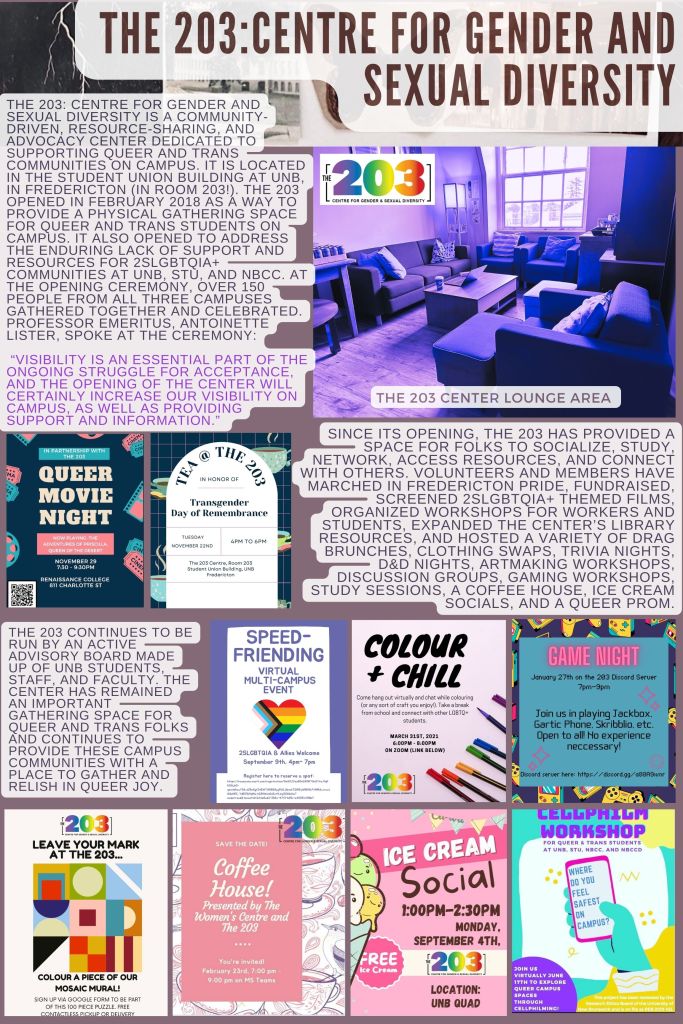
The 203: Centre for Gender and Sexual Diversity is a community-driven, resource-sharing, and advocacy center dedicated to supporting queer and trans communities on campus. It is located in the Student Union Building at UNB, in Fredericton (in room 203!). The 203 opened in February 2018 as a way to provide a physical gathering space for queer and trans students on campus. It also opened to address the enduring lack of support and resources for 2SLGBTQIA+ communities at UNB, STU, and NBCC. At the opening ceremony, over 150 people from all three campuses gathered together and celebrated. Professor Emeritus, Antoinette Lister, spoke at the ceremony:
“Visibility is an essential part of the ongoing struggle for acceptance, and the opening of the Center will certainly increase our visibility on campus, as well as providing support and information.”
Since its opening, The 203 has provided a space for folks to socialize, study, network, access resources, and connect with others. Volunteers and members have marched in Fredericton Pride, fundraised, screened 2SLGBTQIA+ themed films, organized workshops for workers and students, expanded the center’s library resources, and hosted a variety of drag brunches, clothing swaps, trivia nights, D&D nights, artmaking workshops, discussion groups, gaming workshops, study sessions, a coffee house, ice cream socials, and a queer prom.
The 203 continues to be run by an active advisory board made up of UNB students, staff, and faculty. The center has remained an important gathering space for queer and trans folks and continues to provide these campus communities with a place to gather and relish in queer joy.
Panel 4

Before UNB or STU recognized queer and trans organizations at any official level, the relationship between campus organizing and community organizing was blurred. Queer and trans folks in both academic institutions were building intentional communities for themselves within the margins (both on campus and in the broader Fredericton community).
Formed in 1974, Gay Friends of Fredericton (GFF) was the community’s earliest known queer organization–and its membership was directed exclusively towards gay men as a way to provide space for them to socialize and meet. While most of their work happened off campus, its members would occasionally give presentations to classes at UNB (Flavey, 2010).
The founding of FLAG was an important moment for UNB and STU’s queer communities, since faculty, staff, and students would get to know each other at its regularly-held dances and events – some of which were held directly on the UNB campus. while these events were not held in designated queer spaces at the time, they were queered spaces nonetheless (Lister, 2023). During this time, UNB was also often used as a space for other queer organizations from across New Brunswick, Nova Scotia, and Maine to host conferences and hold meetings (Flavey, 2010). Around the same time, the first gay and lesbian newspaper in the community–called Body Politic–started being published (it existed between 1971-87), and the UNB library subscribed to it.
During the 1970s and 1980s, Fredericton was, of course, also home to thriving underground queer activities. ‘Cruising on the Green’ and regular meetups with friends, dates, and partners at The River Room in the Beaverbrook Hotel (now known as The Crowne Plaza) were two popular queer spaces, which UNB and STU faculty, staff and students were most certainly part of (Lister, 2023). As UNB’s professor Emeritus Antoinette Lister recalls, “everything was hush, hush and it was very difficult to meet other gay people. There was a big risk in coming out to anyone, as you couldn’t be certain if they were gay or not. I think that if there were any social activities, they would have been restricted to small groups of friends.”
A 2SLGBTQIA+ group would not be established and recognized at UNB until several years after the founding of FLAG. In 1987, UNB Counseling Services organized a series of talks for 2SLGBTQIA+ students on campus. Following this, a small group of between 10-15 students would continue to meet informally on a weekly basis, with Hal Hinds as their faculty advisor. Hal Hinds was one of the original founders of FLAG and was a prominent gay rights activist during that time.
Shortly after in 1989, GALA-UNB (the Gay and Lesbian Alliance of UNB) was founded by James Gill: UNB’s first recognized 2SLGBTQIA+ group. Student and faculty queer activity during the 1990s began to establish explicit and concrete queer spaces across the two campuses. For instance, Adrian Park, a faculty member at UNB, took over writing for the university newspaper’s gay issue column in the early 1990s and also launched a queer-themed radio show called Fruit Cocktail on the campus’s radio station (Flavey, 2010).
Panel 5

In 2000, GALA moved to the Arts Faculty Lounge, and its name was changed to Spectrum. Spectrum was run as an official club through the UNB student union, and it also served students at STU. For the most part, Spectrum met in the Sexuality Centre (now The 203 Centre) on the second floor of the Student Union Building. Spectrum ran its meetings on Tuesday evenings—normally 8-10 students would show up (but on larger nights, as many as 20 people would attend). Spectrum had an active website which included a calendar of events and links to local resources, they also had a mailing list that folks could subscribe to, and they were given a small budget from the Student Union to print posters, and host open house events and socials. Spectrum also connected queer and trans folks across the campuses—creating an expansive official and unofficial network amongst queer communities. Members were known to help each other out during crisis or in times of need. Spectrum also served graduate students, and one of the faculty advisors was Arthur James—at that time, he was a student in the STU Education program (Bond, 2023).
Alex Bond, an active member of Spectrum, describes: “At the time, the goal of Spectrum was to eventually not have to exist.” He remembers one particular time when the campus was hosting blood donor clinics at the Alumni Memorial Building during the 2006-2007 academic year. At that time, gay men were denied from giving blood, and so Alex and another member of Spectrum set up a table near the blood donor clinic and handed out leaflets calling out the queerphobic nature of the policy.
Alex ran a program called Safe Spaces out of one of the back offices in the sexuality center. Safe Spaces started during the 2003-2004 academic year and was a program that invited people to attend hour-long presentations in the law building on a variety of topics, including community and campus resources, ‘Gender and Sexuality 101’, and other legal issues (at that time in NB, the hot topic was same sex marriage). People who attended these sessions could take a ‘Safe Space’ sticker. These stickers (pictured here) were placed on doors across departments, faculties, residences, and departments.
During the mid 2000s, official queer student organizing on campus largely unfolded through the work of Spectrum. During its weekly meetings, folks would gather to talk about various topics, listen to guest speakers, hang out, host round table discussions, and share food. At that time, there were no officially recognized queer spaces around the community. Boom nightclub was largely run as a dance club, and was not explicitly recognized as a ‘gay bar’, but many folks from the community would gather there (and so it became a gay club). the most queer friendly spaces at the time, Alex Bond remembers, were the Sexuality Centre (where Spectrum and Safe Spaces was run), Boom, and The James Joyce pub.
Spectrum would continue to function and be active on campus until 2017, when it was eventually replaced by a new Association named Qmunity. Together, the members of Qmunity dreamed up a space that would eventually become The 203: A space that would provide a physical place for queer and trans socializing and organizing on campus. Qmunity, along with other faculty and students, eventually formed the Board of The 203. It was decided that The 203 would operate separately from Qmunity, and be guided by its own set of principles, vision, and constitution. Funding was sought to renovate the space where The 203 would exist: The obsolete Sexuality Centre in the Student Union Building.
Panel 6
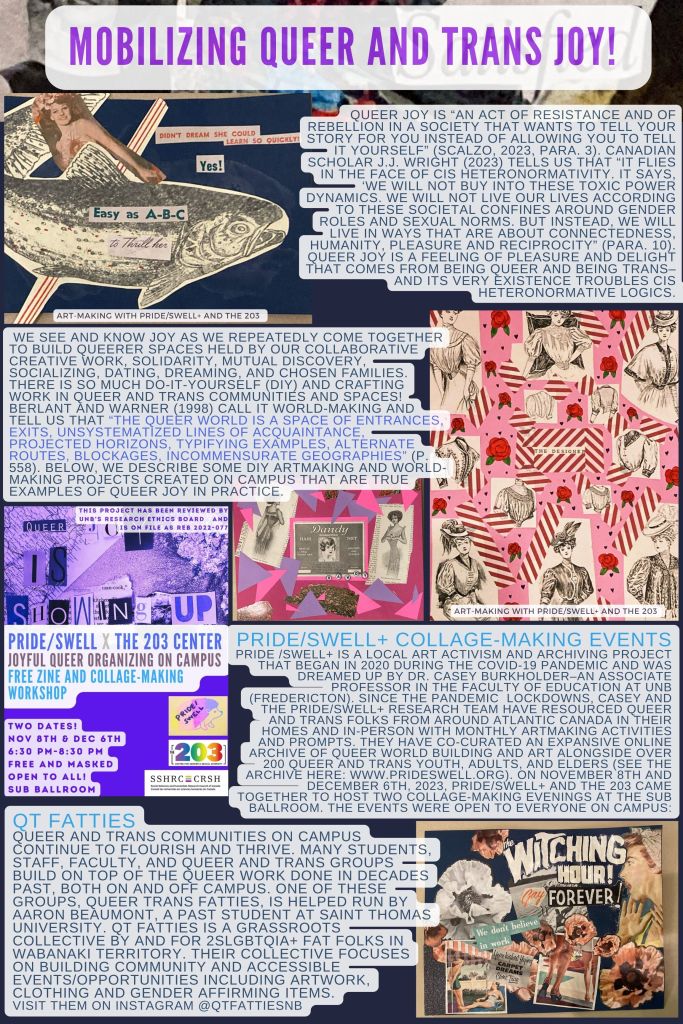
Queer joy is “an act of resistance and of rebellion in a society that wants to tell your story for you instead of allowing you to tell it yourself” (Scalzo, 2023, para. 3). Canadian scholar J.J. Wright (2023) tells us that “it flies in the face of cis heteronormativity. It says, ‘we will not buy into these toxic power dynamics. We will not live our lives according to these societal confines around gender roles and sexual norms. But instead, we will live in ways that are about connectedness, humanity, pleasure and reciprocity” (para. 10). Queer joy is a feeling of pleasure and delight that comes from being queer and being trans–and its very existence troubles cis heteronormative logics.
We see and know joy as we repeatedly come together to build queerer spaces held by our collaborative creative work, solidarity, mutual discovery, socializing, dating, dreaming, and chosen families. There is so much do-it-yourself (DIY) and crafting work in queer and trans communities and spaces! Berlant and Warner (1998) call it world-making and tell us that “the queer world is a space of entrances, exits, unsystematized lines of acquaintance, projected horizons, typifying examples, alternate routes, blockages, incommensurate geographies” (p. 558). Below, we describe some DIY artmaking and world-making projects created on campus that are true examples of queer joy in practice.
Pride/Swell+ Collage-Making Events
Pride /Swell+ is a local art activism and archiving project that began in 2020 during the Covid-19 pandemic and was dreamed up by Dr. Casey Burkholder–an associate professor in the Faculty of Education at UNB (Fredericton). Since the pandemic lockdowns, Casey and the Pride/Swell+ research team have resourced queer and trans folks from around Atlantic Canada in their homes and in-person with monthly artmaking activities and prompts. They have co-curated an expansive online archive of queer world building and art alongside over 200 queer and trans youth, adults, and elders (see the archive here: http://www.prideswell.org). On November 8th and December 6th, 2023, Pride/Swell+ and The 203 came together to host two collage-making evenings at the SUB Ballroom. The events were open to everyone on campus.
QT FATTIES
Queer and trans communities on campus continue to flourish and thrive. Many students, staff, faculty, and queer and trans groups build on top of the queer work done in decades past, both on and off campus. One of these groups, Queer Trans Fatties, is helped run by Aaron Beaumont, a past student at Saint Thomas University. QT Fatties is a grassroots collective by and for 2SLGBTQIA+ fat folks in Wabanaki Territory. Their collective focuses on building community and accessible events/opportunities including artwork, clothing and gender affirming items.
Visit them on Instagram @qtfattiesnb
Panel 7
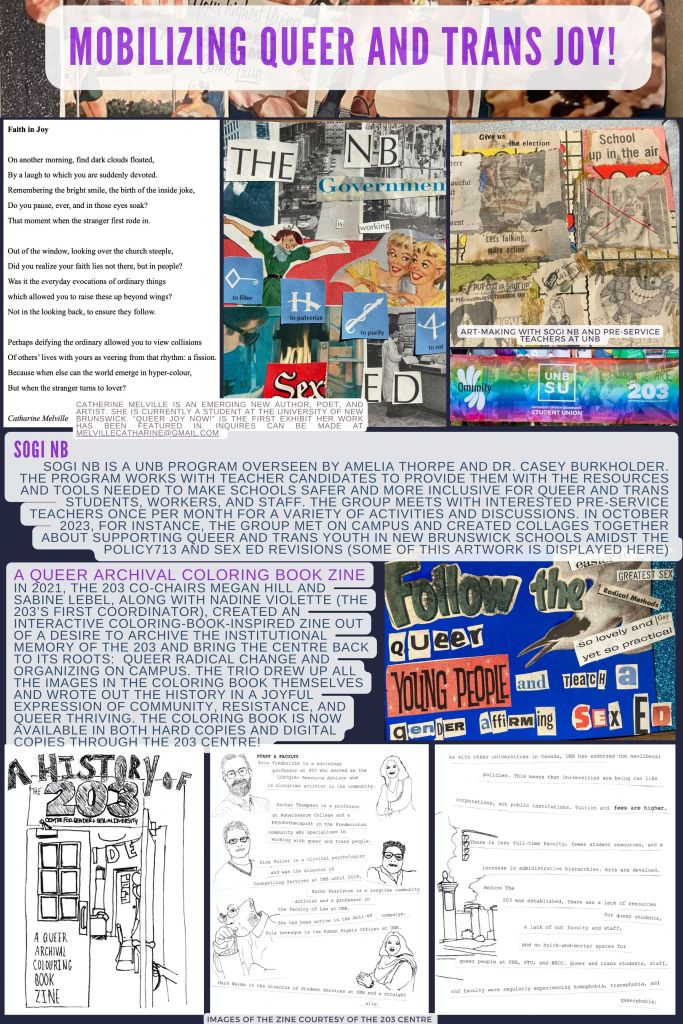
SOGI NB
SOGI NB is a UNB program overseen by Amelia Thorpe and Dr. Casey Burkholder. The program works with teacher candidates to provide them with the resources and tools needed to make schools safer and more inclusive for queer and trans students, workers, and staff. The group meets with interested pre-service teachers once per month for a variety of activities and discussions. In October 2023, for instance, the group met on campus and created collages together about supporting queer and trans youth in New Brunswick schools amidst the Policy 713 and sex-ed revisions (some of this artwork is displayed here).
A queer archival coloring book zine
In 2021, The 203 Co-Chairs Megan Hill and Sabine Lebel, along with Nadine Violette (The 203’s first coordinator), created an interactive coloring-book-inspired zine out of a desire to archive the institutional memory of The 203 and bring the Centre back to its roots: queer radical change and organizing on campus. The trio drew up all the images in the coloring book themselves and wrote out the history in a joyful expression of community, resistance, and queer thriving. The coloring book is now available in both hard copies and digital copies through The 203 Centre!
Panel 8
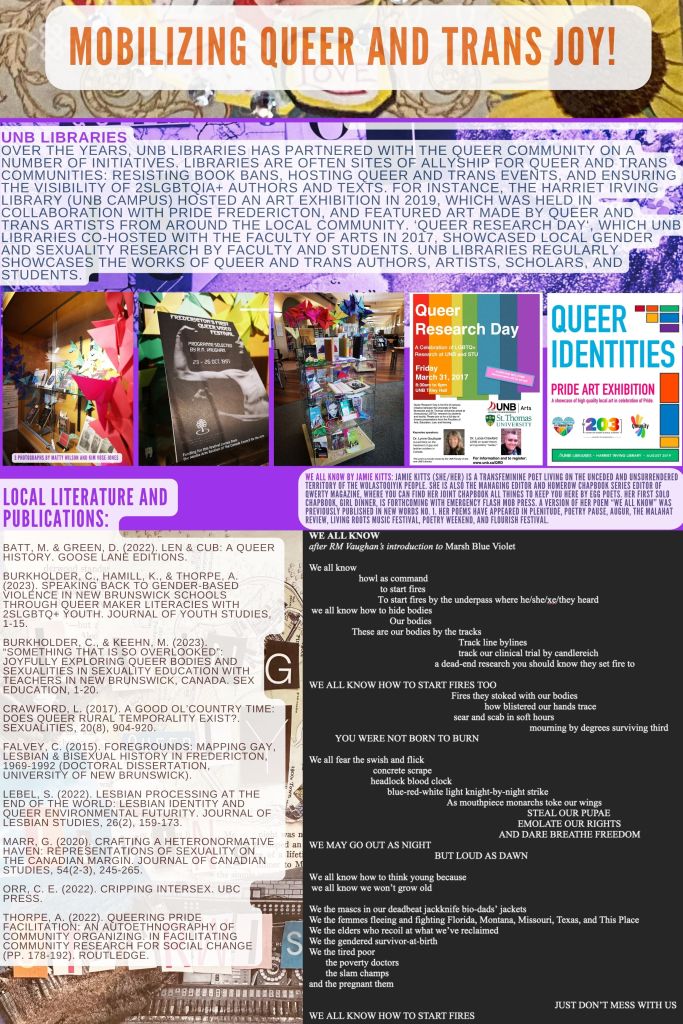
UNB Libraries
Over the years, UNB Libraries has partnered with the queer community on a number of initiatives. libraries are often sites of allyship for queer and trans communities: resisting book bans, hosting queer and trans events, and ensuring the visibility of 2SLGBTQIA+ authors and texts. For instance, the harriet irving library (UNB campus) hosted an art exhibition in 2019, which was held in collaboration with Pride Fredericton, and featured art made by queer and trans artists from around the local community. ‘Queer Research Day‘, which UNB Libraries co-hosted with the Faculty of Arts in 2017, showcased local gender and sexuality research by faculty and students. UNB Libraries regularly showcases the works of queer and trans authors, artists, scholars, and students.
Panel 9
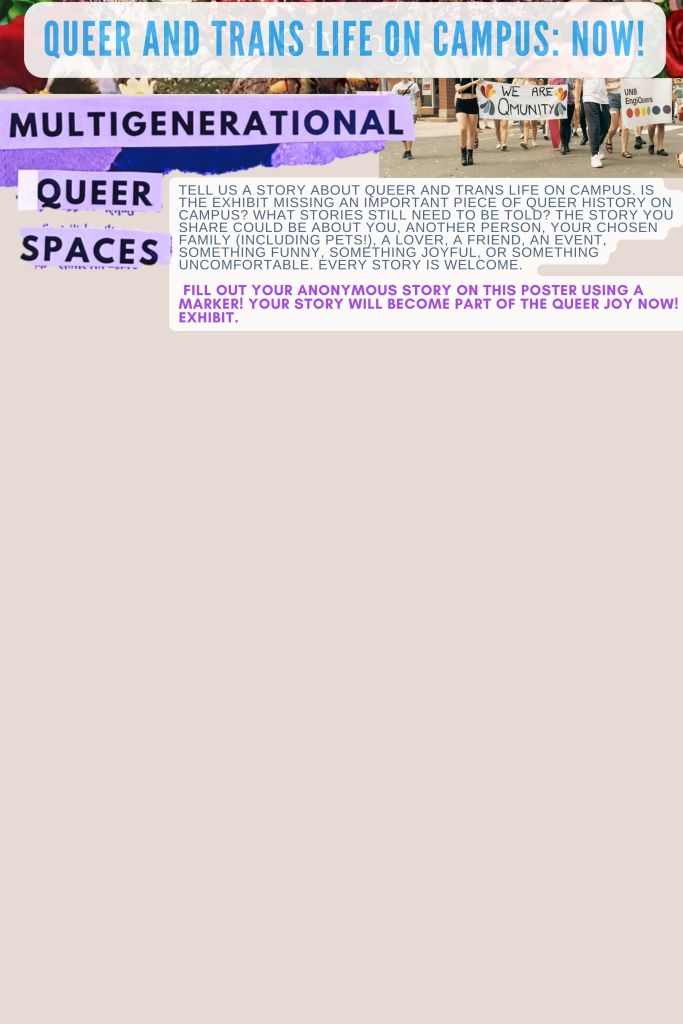
Tell us a story about queer and trans life on campus. Is the exhibit missing an important piece of queer history on campus? What stories still need to be told? The story you share could be about you, another person, your chosen family (including pets!), a lover, a friend, an event, something funny, something joyful, or something uncomfortable. Every story is welcome.
Fill out your anonymous story through the below submission form! Your story will become part of the Queer Joy Now! Exhibit.
Panel 10
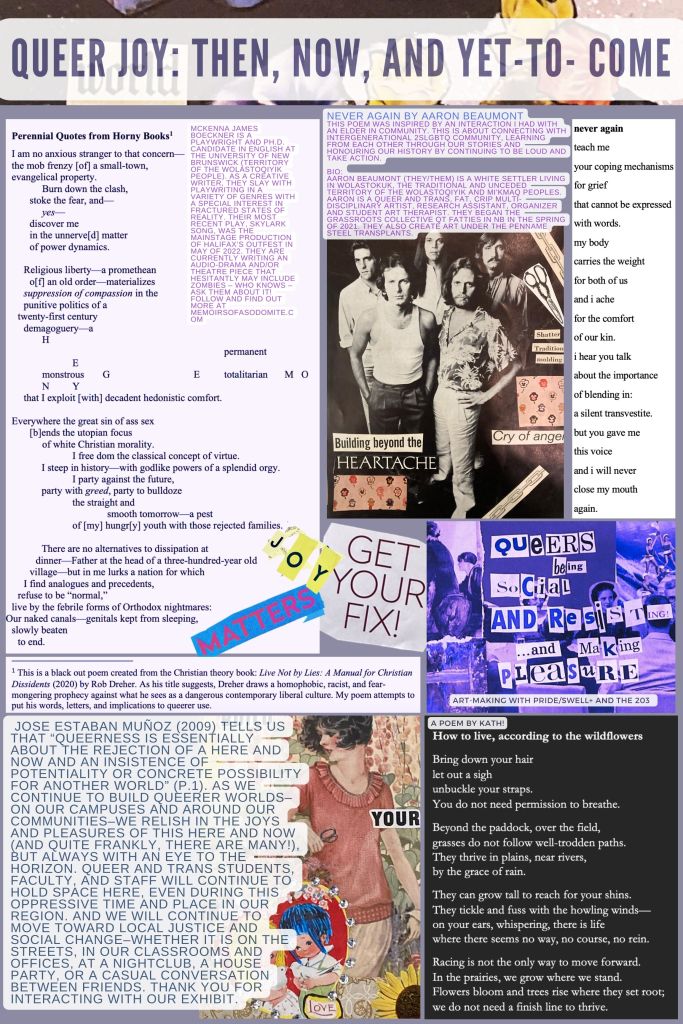
Jose Estaban Muñoz (2009) tells us that “queerness is essentially about the rejection of a here and now and an insistence of potentiality or concrete possibility for another world” (p.1). As we continue to build queerer worlds–on our campuses and around our communities–we relish in the joys and pleasures of this here and now (and quite frankly, there are many!), but always with an eye to the horizon. Queer and trans students, faculty, and staff will continue to hold space here, even during this oppressive time and place in our region. And we will continue to move toward local justice and social change–whether it is on the streets, in our classrooms and offices, at a nightclub, a house party, or a casual conversation between friends.
Thank you for interacting with our exhibit.
 Queer Joy Now!